Tuesday, September 13, 2011

hacking the city, the streets, the copyright

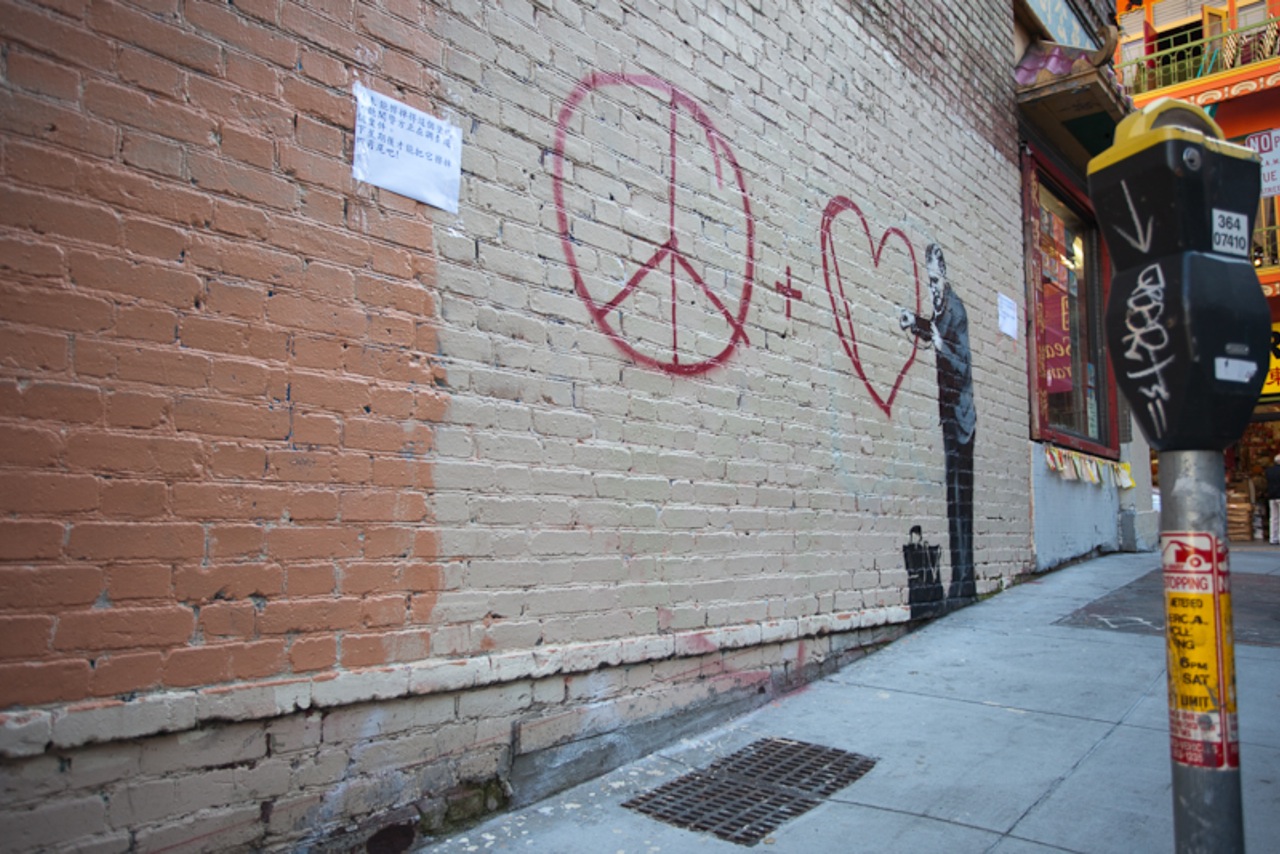
Earlier this summer we were in San Francisco with some friends, trying to reacquaint the kids with Chinatown without breaking anything or getting run over, when we saw a guy painting a brilliant dragon mural that had a big square of plexiglass down in the corner. Here's the Banksy stencil painting, now protected by the City, that he was painting around. As great as it was to see the Banksy painting, it was an even better surprise to see someone now working in the margins of that painting. Wish I'd gotten a photo. Sorry, I guess you'll have to visit Chinatown.

Until then, here are a few movies that I've been into lately that sort of deal with this idea of working and playing in the margins, starting, actually, with Banksy. I'm not out to review them or anything, but I do give them each a bunch of stars.

Exit through the Gift Shop (2010)


Dogtown & Z-Boys (2001)


“Two hundred years of American technology has unwittingly created a massive cement playground of unlimited potential. But it was the minds of 11 year olds that could see that potential”
- Craig Stecyk, 1975


Be Kind Rewind (2008)


Finally, here's one recent take on margins and this question of the cultural commons--not part of the film, don't worry:


“In premodern England, villagers used to annually ‘beat the bounds’ of the commons. Armed with axes, mattocks, and crowbars, they would perambulate the public ways and common fields, demolishing any encroaching hedges, fences, stiles, and buildings that had been erected without permission. To bring formalities back to copyright would nicely beat the bounds of the cultural commons. I doubt it was apparent in the late 1970s that abandoning formalities would amount to a taking from the commons, but that is what it has turned out to be. To restate but one piece of what has already been said: In the old days, with a renewal requirement, 85 percent of all work passed into the public domain after 28 years; now, without it, that sizable portion remains enclosed (uselessly so) for another generation or more.
...
Simply put, by reducing the de facto reach of monopoly privileges, formalities enrich the cultural commons. If they also remind us that copyrights are creatures of positive law, not of natural right, and thus also push back against what might be called ‘conceptual enclosure,’ so much the better.”


related: Moose Curtis, feeding fish

Sunday, September 11, 2011

Walking in the City

The desire to see the city preceded the means of satisfying it. Medieval or Renaissance painters represented the city as seen in a perspective that no eye had yet enjoyed. This fiction already made the medieval spectator into a celestial eye. It created gods. Have things changed since technical procedures have organized an "all-seeing power"?
...
The ordinary practitioners of the city live "down below," below the thresholds at which visibility begins. They walk--an elementary form of this experience of the city, they are walkers, whose bodies follow the thicks and thins of an urban "text" they write without being able to read it. A migrational, or metaphorical city thus slips into the clear text of the planned and readable city.
...
The story begins on ground level with footsteps. They are myriad, but do not compose a series. Their swarming mass is an innumerable collection of singularities. Their intertwined paths give their shape to spaces. They weave places together.
...
The act of walking is to the urban system what the speech act is to language; it is a process of appropriation of the topographical system on the part of the pedestrian (just as the speaker appropriates and takes on the language).
...
We could mention the fleeting images, yellowish-green and metallic blue calligraphies that howl without raising their voices and emblazon themselves on the subterranean passages of the city, "embroideries" composed of letters and numbers, perfect gestures of violence painted with a pistol, Shivas made of written characters, dancing graphics whose fleeting apparitions are accompanied by the rumble of subway trains: New York graffiti.
...
The childhood experience that determines spatial practices later develops its effects, proliferates, floods private and public spaces, undoes their readable surfaces, and creates within the planned city a "metaphorical" or mobile city.


-- Michel de Certeau, 1984

Friday, September 09, 2011

Chinatown haiku


all right. here we are
neighborhood of make-believe
museum-go-round

cable car trolley
ore skip of the surface streets
every body off

there, in the middle
of your post card, he gestures,
that's my Acura

speaking so softly
and with their haricuts
Indios take pictures


*
related: early summer, looking up, accident, waiting, wooden cars

Tuesday, September 06, 2011

lucky eyes, evil eyes, third eyes

You know the bindi? The colored dot some Indian women traditionally wear on their foreheads? Ash is really into bindis, ever since she saw little girl with on in one of her story books. Now, for the last couple months, everyone she draws gets a bindi. Herself, me, Kelly, Tom, the Sun, Grandpa Rem. These are giant bindis too. More like great big moles, or dark, mystical third eyes. Here are a few examples, in watercolor and highlighter.


Tom's deal, on the other hand, is quite different. Earlier this year he started doing this thing (mostly when we're sitting at the table, trying to eat dinner or something) where he lowers his chin to his chest and says "two Moms," or "two Ashes," or "two grapefruits." We couldn't figure it out at first, but soon realized that he was going walleyed (I think the medical term would be exotropia/exotropic), giving himself double-vision.

I'm not sure whether it's fair to blame/credit the nazar charm a Turkish friend of ours gave him last summer, but it has been hanging over his bed from a mobile for the past year, keeping the evil eye off.

Should I call these things "talents"? If so, they're ones I don't mind encouraging, especially if, in Tom's case, it might eventually place him among such distinguished company as, say, Peter Lorre, Marty Feldman, and (Dad, you'll like this) Leo McKern.


related: ash draws

Monday, September 05, 2011

Pedestrain Day(s) in Bolivia

"What's the matter with you?! Today is Pedestrian Day; you can't drive!" shouted Jorge, an offended seven-year-old who was playing soccer with his friends on the Avenida Esteban Arze de Villa San Antonio. For just a moment, an authorized vehicle had broken through his improvised soccer field.

This is how the front page article begins in today's la Razón, Bolivia's national daily newspaper. Yesterday Bolivia cleared about 2 million cars from the streets in nine cities, calling it, officially, if not very succinctly, "National Pedestrian and Cyclist Day in Defense of Mother Earth."


Volleyball, street markets, music and dancing, kids throwing tops, hundreds of bikes (a lot of them on the freeways), people playing hopscotch in zebra costumes, old Chola ladies in bowler hats doing tai chi, etc. Of the forty or so people that got busted for driving, one was someone from the mayor's office, another it turns out, a drunken senator.

There's a video montage over here with this little article from the bbc, and maybe check out the general wikipedia article on car-free days.

As fabulous as this all is, though, it's worth noting here that Bolivia's real pedestrian event actually began last month, when over 1000 Bolivian Indians started marching 400 or so miles--from the Amazon Basin up to La Paz, at 12,000 feet elevation!--to protest a new highway through TIPNIS (Isibordo Sécure National Park and Indigenous Territory) land.


some more details (English), and 16 minutes of interviews (Spanish)

related (offsite): patagonia sin represas

Saturday, August 27, 2011

endless tide pools

some photos I've been meaning to post for the last month.


mono lake, on the eastern sierra


caves and beach house ruins at crystal cove


maguey flowers & Tom finds some pickleweek, gooseneck barnacles


some big sea hares!


and did you know that this creature is an anemone?
not, as I had always thought, an "anenome".
right. I know. I feel like I've been saying "liberry" all these years.


related: capybaras & barnacle geese, cacti, the snout, the obliging cephalopod, (endless pools), august moon

Friday, August 26, 2011

firmament


this will appear along with two other images as part of an article on Mormon mysticism in the next Sunstone magazine.

related: dream mine, 3 grand keys

Thursday, August 04, 2011

wide conqueror

If you’re scheming something to do with old tires, looking for ideas and examples, there’s a fine line between inspiration and intimidation. Considering what people have been doing with spent tires, there’s plenty to envy in the way of resourcefulness and craftsmanship.

the GIANT robots & dinosaurs at this Tokyo tire park


there's Dr. Mars J. Läns’ Earth Tire Foundation

(Check out Mars & Rita in the studio, tricking out a shopping cart, and posing with mayors and senators.)


Inspiration Green (a beautiful and killer site!) has a page cataloging all kinds of uses for tires in art and design. Here's just a little selection.


And, finally, there's Go Play!’s fabulous open-source playground movement. If you like this, you may also want to visit Arcady's playscapes blog.


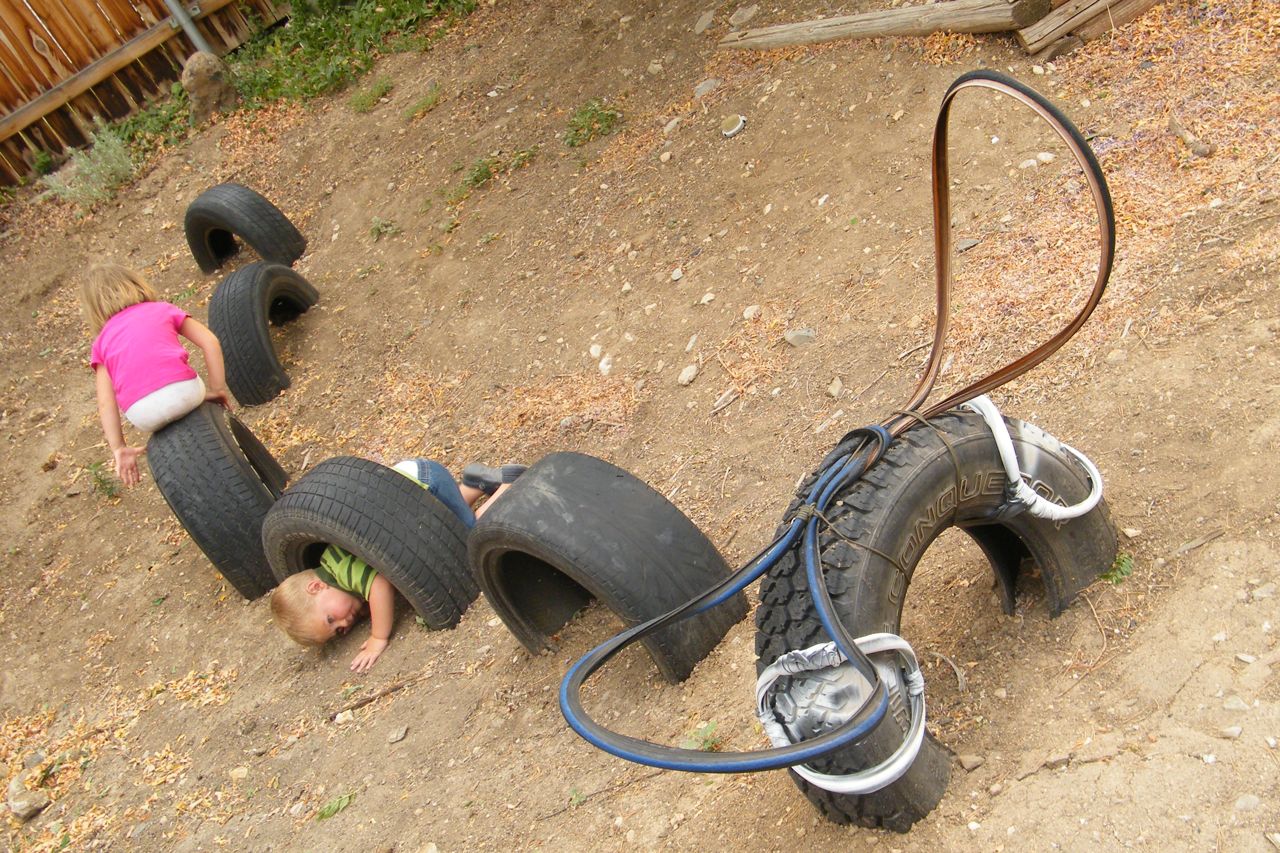
So by the time I finally found the celebrated Ray’s Tire Exchange here in town (under the Wells Avenue overpass) I already had a general idea of what I wanted to do. I was thinking of something a 40 lb kid could bounce and climb on, but also crawl under/through. Something that might get them dirty, but not that they were going to cut or strangle themselves on. Also, if I could make it look like some kind of monster, all the better.

While I was in getting the tires, Ash and Tom did a good job waiting patiently in the truck--partly because I told them this was about building something fun, and I think partly because it was an unfamiliar part of town, where they felt more inclined to sit tight than to get out and wander. Sure enough, Ray’s had heaps of them, and the perfect “whatever. over there’s the scrap pile. help yourself” attitude.


We took home 6 tires and, for now, this is what we came up with. I worked a few old bike tires into it too and, aside from those, there was no sawing or chopping of rubber or steel belts here. But if you’re looking for encouragement in this direction, here's a short, surprisingly soothing video about how to cut up tires for stuff like this.

Of course there's no guarantee that anything you make will stay that interesting for very long, especially when there's hanging laundry to play in; it gets hard to compete.

related: clothesline, toys, edward burtynsky