Sunday, August 26, 2018

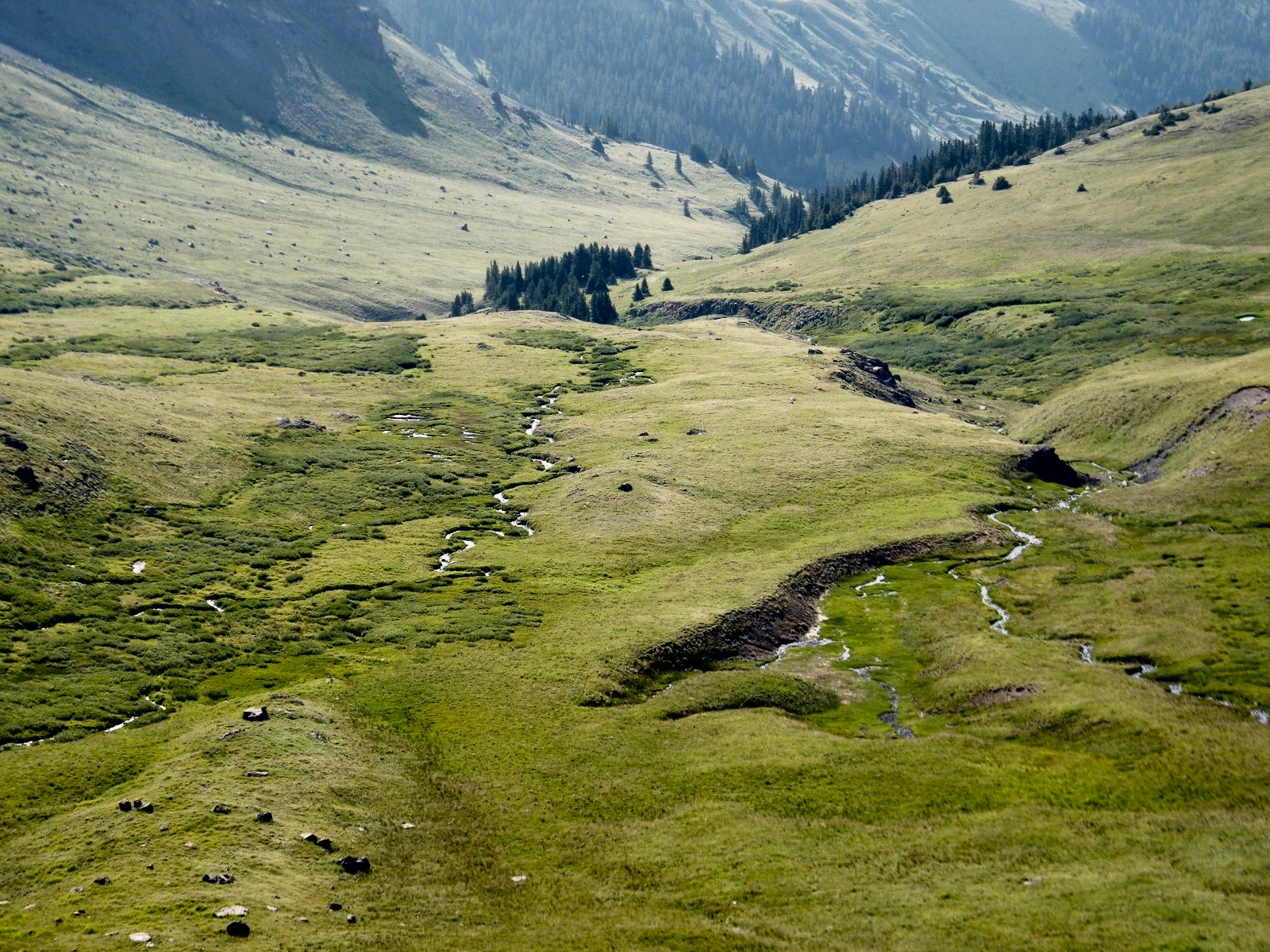
90 miles in the San Juans


Weminuche with Lamar


Strawberry fields. Then things get real. Hailstorm & lightning over Skyline/Opal pass. (My children are all born and named, but if yours are not, you might consider Skyline Opal for the shortlist.)


Window over Continental Divide:  Colorado River over yonder, Rio Grande that-a-way.


Climbing out over Rock Lake.


Uncompahgre with Brian


“Acabamos de bajar la sierra y entramos en las riberas y vegas del río de San Francisco, nombrado de los yutas ancapagri (que según el intérprete dice Laguna Colorada) porque dicen haber cerca de su nacimiento un ojo de agua colorada, caliente, y de mal gusto. En esta vega del río, que es grande y muy llana, hay una camino muy ancho y trillado. Por él río abajo anduvimos legua y media al noreste, y paramos junto a una ciénega grande muy abundante de pastos que nombramos La Ciénega de San Francisco. Hoy cinco leguas.”

“We finished descending the sierra and came upon the banks and meadows of El Río San Francisco—among the Yutas called Ancapagari (which, according to our interpreter, means Red Lake), because they say that near its source there is a spring of red-colored water, hot and ill-tasting. On this river meadow, which is large and very level, there is a wide and well-beaten trail. We went along it downstream for a league and a half northeast and halted next to a big marsh greatly abounding in pasturage, which we named La Ciénega de San Francisco. Today five leagues.”

—from The Domínguez-Escalante Journal, Fray Silvestre Vélez De Escalante (August 26, 1776)

(Or, as Brian put it, “This water tastes like a bloody nose.”)


Backpacking with a geologist is a to have the rocks read to you, a tour through deep time: andesite, breccia, porphyry, intrusive dikes.

Also, plenty of time to talk movies. Hunt for the Wilderpeople, Star Warsessss, Big Lebowski, Never Cry Wolf, Dr. Strangelove, The Future is Unwritten, and so on.  (And, of course, Rubin and Ed, and its longstanding efficacy as a friendship-compatibility test.) Here Brian explains why he didn’t care for La La Land.


Brian takes real pictures.


Coyote, pika, sheep, Uncompahgre fritilary butterfly.


Nice marmot.

Saturday, August 18, 2018

3 tunes for summer (1 homemade, 2 store-bought)


reeds & sticks on Vimeo.
  • rusty glockenspiel, Sand Island campground (San Juan River)
  • woodcutting picnic, Manti-La Sal National Forest
  • searching for a scale on Paleozoic grasses, Calf Creek (Grand Staircase-Escalante)
  • Sunbeam Hot Springs, on the Salmon River (inna rub-a-dub stylee!)


kin: aguas, mineral spirits, Tacvba


Monday, July 30, 2018

signs & signifiers


“In the morning, I open my window above a plump and tiger-striped lizard, and she opens her blue mouth wide in return. Nature is an idiot savant, profoundly gifted at the mathematics of being, but damned if she can make a single reliable word come out of her mouth.”
— Mark Tredinnick from Fire Diary (2010)


Yes. Or, turn the coin over:

I want to tell what the forests
were like
I will have to speak
in a forgotten language
— W.S. Merwin, “Witness” (1988)


por ejemplo:

“Con un hisopo entintado marcó cada cosa con su nombre: mesa, silla, reloj, puerta, pared, cama, cacerola. Fue al corral y marcó los animales y las plantas: vaca, chivo, puerco, gallina, yuca, malanga, guineo. Poco a poco, estudiando las infinitas posibilidades del olvido, se dio cuenta de que podía llegar un día en que se reconocieran las cosas por sus inscripciones, pero no se recordaba su utilidad. Entonces fue más explícito. El letrero que colgó en la cerviz de la vaca era una muestra ejemplar de la forma en que los habitantes de Macondo estaban dispuestos a luchar contra el olvido: Esta es la vaca, hay que ordeñarla todas las mañanas para que produzca leche y a la leche hay que hervirla para mezclarla con el café y hacer café con leche. Así continuaron viviendo en una realidad escurridiza momentáneamente capturada por las palabras, pero que había de fugarse sin remedio cuando olvidaran los valores de la letra escrita.”

“With an inked brush he marked everything with its name: table, chair, clock, door, wall, bed, pan. He went to the corral and marked the animals and plants: cow, goat, pig, hen, cassava, caladium, banana. Little by little, studying the infinite possibilities of a loss of memory, he realized that the day might come when things would be recognized by their inscriptions but that no one would remember their use. Then he was more explicit. The sign that he hung on the neck of the cow was an exemplary proof of the way in which the inhabitants of Macondo were prepared to fight against loss of memory: This is the cow. She must be milked every morning so that she will produce milk, and the milk must be boiled in order to be mixed with coffee to make coffee and milk. Thus they went on living in a reality that was slipping away, momentarily captured by words, but which would escape irremediably when they forgot the values of the written letters.” 

— from Cien años de soledad/One Hundred Years of Solitude, Gabriel García Márquez (1967)


kin: the witness, ciphers, another way