
Friday, September 26, 2014

Thursday, August 21, 2014
(we) dove
Speaking of entering the adult world, we just bought our
first house. Or, maybe more precisely, signed a thick stack of paper promises
to incrementally buy a house while we live in it and treat it like our own.
This is all still sinking in, but in the mean time we’re very pleased.
A few minutes into our first visit to the loan office we
noticed a mother dove tending her nest, tucked under the eaves of the building
next door, her dark yellow eye staring in at us through the window. On our
second visit (more papers), we brought the camera. She was gone, but now there
were eggs in her nest.

Once, a couple years ago, Ash asked me, “are animals poor?”
She was 5 at the time, and I think we had just been watching
swallows build their muddy nests onto the steel girders under a bridge. “Are
animals poor?”
She had asked essentially this same question a couple of
times earlier. Once when we were walking along the Truckee River and saw a man
in ragged clothes sleeping under a picnic table. And again when we were
carrying all of our food and shelter into the mountains on our backs for the
night. “Are animals poor?”
Where does one begin?
I think I probably started in with some Thoreauvian patter
about how, well, that all depends on what you mean by poor. How we’re wealthy
in relation to all the things we can afford to, or are glad to, do
without, and so on.
She didn’t seem to be buying it.
“Yeah, but I mean if animals don’t have a nice place to
sleep, like people, are they poor?”
This same basic question continues to come up from time to time.
When the power goes out.
When after walking across the great concrete bridge at the
mouth of the Siuslaw River, we stumble into the rising smoke and bearded faces
of a hobo camp in the ferns and pines.
When a deer limps across the road at dusk, followed by her
fawns.
Or when, chasing a woodpecker into the eucalyptus forest
behind our motel on the Mendocino coast, we instead find the handsomely tended
tent-and-tarp shelter of somebody still not returned home from work for the
day.
I’m still working on a better answer.
Tuesday, July 08, 2014
Into the Mystic, and a procession of ontologies
One morning, earlier this summer, we were driving north along
the Salmon River in Idaho when Van Morrison came on the radio.
We were born before the wind
Also younger than the sun
Ere the bonnie boat was one as we sailed into the mystic
. . .
Just about there, Tom called right out from the back seat, with something
between amusement and scandal, “we weren’t born before the wind!” We had all
day to get to Missoula, so of course, this led to a longer conversation.
“What do you think he’s singing about?”
And so it went.
We never set out to make positivists of these kids, as they
come to us little animists, playing in the outskirts of our rational,
grown-up world. But here is one game that we’ve played with them. I guess it doesn’t
really have a name, but it goes something like this:
“Which came first, gates or bait?”
(Followed by speculations and reasoning all around, until resolved to everyone’s basic satisfaction.)
(Followed by speculations and reasoning all around, until resolved to everyone’s basic satisfaction.)
Which came first, poles or holes?
Red or black?
Jerks or jerky?
Shoes or blue?
And so on.
Here’s another. Is a thing good or bad? Grasshoppers, Snow,
Cheatgrass, Lightning, and so on.
“Are roads good?”
“Yes, for people. No for prairie dogs.”
“Yes, for ravens. No for Raccoons.”
Anyway, you get it.
related: about toys, madrugada, 3 short improvised plays
Friday, June 20, 2014
~3,000 miles


Wednesday, June 11, 2014
8 states bird list: May 24—June 9
Pileated Woodpecker
Acorn Woodpecker
Acorn Woodpecker
Hairy Woodpecker
Red-naped Sapsucker
Northern Flicker
Red-breasted Nuthatch
Brown Creeper
Common Raven
Scrub Jay
Steller’s Jay
Yellow-headed Blackbird
Red-winged Blackbird
Brewer’s Blackbird
Northern Mockingbird
Mountain Bluebird
Mountain Chickadee
Black-capped Chickadee
Chestnut-backed Chickadee
Oregon Junco
White-crowned Sparrow
Chipping Sparrow
Song Sparrow
Lark Sparrow
Spotted Towhee
American Robin
Townsend’s Solitaire
StarlingRockPigeonHouseSparrow
Eurasian Collared Dove
Golden Eagle
Bald Eagle
Northern Harrier
Osprey
Red-tailed Hawk
American Kestrel
Turkey Vulture
Common Nighthawk
Purple Martin
Violet-green Swallow
Cliff Swallow
Barn Swallow
Western Meadowlark
Mourning Dove
Anna’s Hummingbird
House Finch
Lesser Goldfinch
Pacific-slope Flycatcher
Western Kingbird
Yellow-rumped Warbler
Wilson’s Warbler
Belted Kingfisher
Ruffed Grouse (just heard, not seen)
Blue/Dusky Grouse
California Quail
Wild Turkey
Spotted Sandpiper
American Dipper
Black-necked Stilt
Ring-billed Gull
Western Gull
Pelagic Cormorant
Double Crested Cormorant
Pigeon Guillemot
Canada Goose
Brown Pelican
White Pelican
Mallard
Common Merganser
Western Grebe
Pied-billed Grebe
Sandhill Crane
Great Egret
Tuesday, June 10, 2014
3 views of trash: washed ashore (there is no "away")


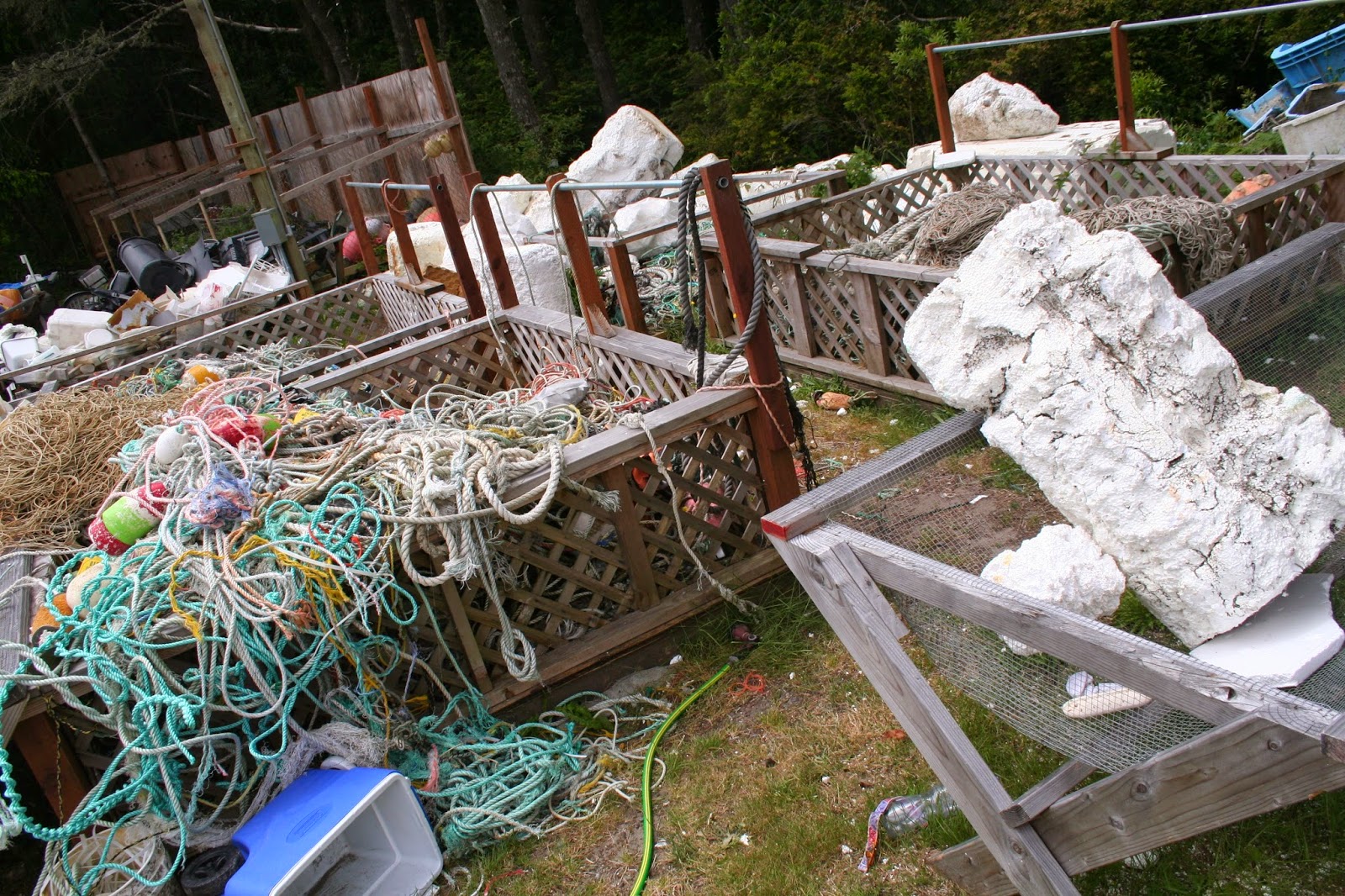


from Angela Hazeltine Pozzi's Washed Ashore project, Bandon, OR (off season)


Monday, May 05, 2014
3 views of trash: sea (tsunami & islands)

from Chris Jordan’s Running the Numbers II project


Bonnie Louise Monteleone & the Plastic Ocean Project

detail from Basurama’s Trash Tsunami in Santo Domingo, DR

Of course, there's always a darker, less sanitized side to this trash business, too. For example, Chris Jordan explores this from about the starkest, most direct angle possible: in situ photos of decomposing albatross carcasses, dead of starvation having filled their bellies with inedible sea plastics.


This is from his Midway project, shot in the general neighborhood of the infamous pacific trash vortex. (Also known affectionately as the great pacific garbage patch, more wishfully as the plastic beach, or, simply, "the gyre.") Here at Midway Atoll, this includes Albatross chicks who are fed small pieces of plastic by unsuspecting parents, eventually killing them. This is a series with far too many photos. And if we're talking about taking plastics and other chemical toxins into our bodies, we know that albatrosses are certainly not alone as a species in this.
Like many, I think there are serious problems with aesthetizing waste and toxicity. Jordan nods to some of this on Midway, and on earlier projects, like his Intolerable Beauty. But you see this ambivalence in that Gorillaz album, for example, as Murdoc describes his discovery of the "plastic beach." And you see it in people's attempts to describe these places and phenomena. Like where surfer Tim Silverwood explains: "I was frolicking in cinematic heaven before quickly being swamped by a feeling of being delivered into a postcard of oceanic hell."
Are these boldly aesthicized (and fetishized?) representations worth the strategic risks of normalizing trash? Of making it seem benign, or even beautiful? Are they necessary and inevitable points along the arc of our realizing long-ignored horrors? Drawing us through understandings of "litter" as less an ecological problem than an aesthetic one, but then flipping this to reckon with the larger scales of consumerism, waste, and toxicity as massive "environmental" and public health crises?
This is from his Midway project, shot in the general neighborhood of the infamous pacific trash vortex. (Also known affectionately as the great pacific garbage patch, more wishfully as the plastic beach, or, simply, "the gyre.") Here at Midway Atoll, this includes Albatross chicks who are fed small pieces of plastic by unsuspecting parents, eventually killing them. This is a series with far too many photos. And if we're talking about taking plastics and other chemical toxins into our bodies, we know that albatrosses are certainly not alone as a species in this.
Like many, I think there are serious problems with aesthetizing waste and toxicity. Jordan nods to some of this on Midway, and on earlier projects, like his Intolerable Beauty. But you see this ambivalence in that Gorillaz album, for example, as Murdoc describes his discovery of the "plastic beach." And you see it in people's attempts to describe these places and phenomena. Like where surfer Tim Silverwood explains: "I was frolicking in cinematic heaven before quickly being swamped by a feeling of being delivered into a postcard of oceanic hell."
Are these boldly aesthicized (and fetishized?) representations worth the strategic risks of normalizing trash? Of making it seem benign, or even beautiful? Are they necessary and inevitable points along the arc of our realizing long-ignored horrors? Drawing us through understandings of "litter" as less an ecological problem than an aesthetic one, but then flipping this to reckon with the larger scales of consumerism, waste, and toxicity as massive "environmental" and public health crises?
Saturday, May 03, 2014
3 views of trash: land (the parts we throw away)
When this Landfill Harmonic trailer first came out a year or
so ago, I got several different emails from friends and family linking me here
and there. Since I’ve never been to Paraguay, and as I have no musical talent to
speak of, I’m left to attribute this coincidence to a known interest on my part
in garbage and various sorts of cheapskatery.
This may also account for why I’ve been so into
what people like Vik Muniz and Chris Jordan have been doing with trash too.
Anyway, earlier this spring, I was able to work along similar lines (but on a much less ambitious project) with somecolleagues
friends and students. Aside from Muniz and Jordan, some of our inspiration here
comes from Chuck Close, Zac Freeman, pointillism more generally, and other upcycling
projects.
Anyway, earlier this spring, I was able to work along similar lines (but on a much less ambitious project) with some
So, here’s what we came up with:
And a little story from the local paper.
(Above the fold and
in color! Not bad, eh?)

Subscribe to:
Posts (Atom)


