A week or so ago a Turkish farmer went out to his field and found a dead bird there. The bird was a European Bee-eater, and it had an aluminum band around its ankle, the kind used to track migration patterns and other behavior. Because the band said “Israel Tel Aviv,” and because the bird’s nostrils were unusually large or asymmetrical (?) they took the body under suspicion for espionage.
The BBC and, of course, a lot of Israeli papers and blogs picked this up originally from Turkish national daily Haber Turk. NPR’s The World ran a good story on it yesterday, where they also get into similar incidents with vultures, sharks, and squirrels—worth a listen.
Incidentally, if you haven’t seen a Bee-eater, take a minute to google. They’re pretty magnificent.
Carrier pigeons and naval dolphins aside, where might this paranoia and narcissism be coming from? Why is it that when non-human animals show a little of their own initiative, we can recognize this as agency, but only so far as we see ourselves acting as agents through animals?
Actually, the real reason I’m posting on all this is just an excuse to bring the conversation around to Leonard Six, a favorite movie for sleepovers when I was growing up. Basically, Bill Cosby is a superhero trying to save San Francisco and the rest of the free world from a vegetarian dystopia, where animals (trout, lobsters, frogs, &c.) are trained to be assassins.
Here’s a clip of ‘80s Roger Ebert ranting about just how much he loathes the movie. This is worth watching mainly to see Ebert gradually overtaken by a sort of fungus that first infests his sweater-vest, then comes on more aggressively toward the end as a kind of holographic starfish!
related: crow machine, costa rica bird list, the synaesthetic puppy
Wednesday, June 20, 2012

Friday, June 15, 2012
stillwater & the great basin abstract
Nevada’s is the most militarized landscape in the country. That is, with so little water and so much open space, there are about 4 million acres here designated for firing rockets, dropping bombs, and otherwise running around in the desert training people and testing things.
Also, because vast expanses of dry, remote, federally-held land tends to resist the smear of suburban sprawl, places like Stillwater National Wildlife Refuge and Fallon Naval Air Station (NAS) can occupy the same airspace.

Fallon’s NAS is the largest naval air station in the West, and the largest electronic warfare range in the world. The interpretive signs at Stillwater also riff on this incongruity.


Tom with some cliff swallows.

Ash and a Super Hornet (?) fighter plane.


swallow nests. Ash checking the guano.

climbing around on six thousand year old petroglyphs (Grimes Point) at the old shoreline of Pleistocene Lake Lahontan.

ten million year old lizards (Ash took this photo).
Also, because vast expanses of dry, remote, federally-held land tends to resist the smear of suburban sprawl, places like Stillwater National Wildlife Refuge and Fallon Naval Air Station (NAS) can occupy the same airspace.

Fallon’s NAS is the largest naval air station in the West, and the largest electronic warfare range in the world. The interpretive signs at Stillwater also riff on this incongruity.


Tom with some cliff swallows.

Ash and a Super Hornet (?) fighter plane.


swallow nests. Ash checking the guano.

climbing around on six thousand year old petroglyphs (Grimes Point) at the old shoreline of Pleistocene Lake Lahontan.

ten million year old lizards (Ash took this photo).
Sunday, June 10, 2012





Tuesday, June 05, 2012
of taxonomies II (the tangled banks)
“… John Wilkins, around 1664, started to [divide] the universe in forty categories or classes, these being further subdivided into differences, which was then subdivided into species. He assigned to each class a monosyllable of two letters; to each difference, a consonant; to each species, a vowel. For example: de, which means an element; deb, the first of the elements, fire; deba, a part of the element fire, a flame.
… Beauty belongs to the sixteenth category; it is a living brood fish, an oblong one.
These ambiguities, redundancies and deficiencies remind us of […] a certain Chinese encyclopaedia entitled 'Celestial Empire of benevolent Knowledge'. In its remote pages it is written that the animals are divided into:
(a) belonging to the emperor
(b) embalmed
(c) tame
(d) sucking pigs
(e) sirens
(f) fabulous
(g) stray dogs
(h) included in the present classification
(i) frenzied
(j) innumerable
(k) drawn with a very fine camelhair brush
(l) et cetera
(m) having just broken the water pitcher
(n) that from a long way off look like flies.”
Jorge Luis Borges, from The Analytical Language of John Wilkins.

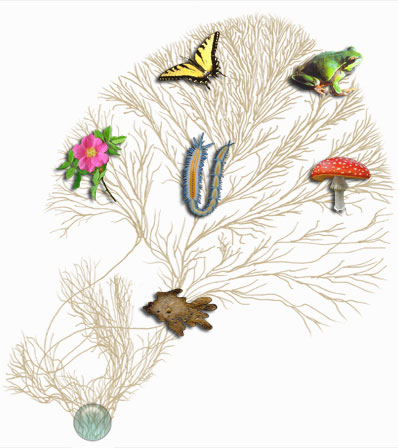
Then yesterday, a week or so after Carl Linnaeus 305th birthday, the NY Times ran an article by Carl Zimmer on this new Open Tree of Life Project (OpenTree). Basically, we’re trying to sort out everything we call living. Zimmer explains.
“Until recently, a complete tree of life would have been inconceivable. To figure out how species are related to one another, scientists inspect each possible way they could be related. With each additional species, the total number of possible trees explodes. There are more possible trees for just 25 species than there are stars in the universe.
… The first goal of the project, known as the Open Tree of Life, is to publish a draft by August 2013. For their raw material, the scientists will grab tens of thousands of evolutionary trees that are archived online. They will then graft the smaller trees into a single big one.”
Smaller trees like the beetle tree of life (BToL) and the liverwort tree of life (LiToL), for example. And, apparently, this is not to be confused with the Tree of Life Project (ToL), or Assembling the Tree of Life (AToL) which have been going on since the mid-90s.
But it’s still tricky for some things, like microbes.
“The branches of the tree of life represent how organisms pass their genes to their descendants. But microbes also transfer genes among one another. Those transfers can join branches separated by billions of years of evolution.”
related: encyclopedia of life, tiktaalik
… Beauty belongs to the sixteenth category; it is a living brood fish, an oblong one.
These ambiguities, redundancies and deficiencies remind us of […] a certain Chinese encyclopaedia entitled 'Celestial Empire of benevolent Knowledge'. In its remote pages it is written that the animals are divided into:
(a) belonging to the emperor
(b) embalmed
(c) tame
(d) sucking pigs
(e) sirens
(f) fabulous
(g) stray dogs
(h) included in the present classification
(i) frenzied
(j) innumerable
(k) drawn with a very fine camelhair brush
(l) et cetera
(m) having just broken the water pitcher
(n) that from a long way off look like flies.”
Jorge Luis Borges, from The Analytical Language of John Wilkins.
Earlier this year the International Botanical Society decided that in order to be officially recognized (by people) as a plant, you no longer have to wait two years to get a Latin name and description, and print publication. As of January 1st, an English name and description will now do fine, according to the new International Code of Botanical Nomenclature. This goes for fungus and algae too, and is mainly an effort to try to stay ahead of the mass extinctions we’ve been bringing about. A “dead” language is no longer quick enough to catch and hold these species for us.
Then yesterday, a week or so after Carl Linnaeus 305th birthday, the NY Times ran an article by Carl Zimmer on this new Open Tree of Life Project (OpenTree). Basically, we’re trying to sort out everything we call living. Zimmer explains.
“Until recently, a complete tree of life would have been inconceivable. To figure out how species are related to one another, scientists inspect each possible way they could be related. With each additional species, the total number of possible trees explodes. There are more possible trees for just 25 species than there are stars in the universe.
… The first goal of the project, known as the Open Tree of Life, is to publish a draft by August 2013. For their raw material, the scientists will grab tens of thousands of evolutionary trees that are archived online. They will then graft the smaller trees into a single big one.”
Smaller trees like the beetle tree of life (BToL) and the liverwort tree of life (LiToL), for example. And, apparently, this is not to be confused with the Tree of Life Project (ToL), or Assembling the Tree of Life (AToL) which have been going on since the mid-90s.
But it’s still tricky for some things, like microbes.
“The branches of the tree of life represent how organisms pass their genes to their descendants. But microbes also transfer genes among one another. Those transfers can join branches separated by billions of years of evolution.”
related: encyclopedia of life, tiktaalik
Monday, June 04, 2012
of taxonomies I
it's been a good while since we've seen a nice human-animal hybrid here on fish without faces. this one comes courtesy of Ash.

got that? it's Minnie Mouse.
but don't worry. we didn't let her watch They Live.
she came up with this on her own.
on this note, did you hear the Radiolab on the taxonomy of monsters, robots, and dolls?
related: school bell, rat fink

got that? it's Minnie Mouse.
but don't worry. we didn't let her watch They Live.
she came up with this on her own.
on this note, did you hear the Radiolab on the taxonomy of monsters, robots, and dolls?
related: school bell, rat fink
Friday, May 11, 2012
sooo 2008

just Richard Rolle’d my forty or so sophomore humanities students who were looking for the fourteenth-century English mystic, to do some last minute extra credit.
not cool for at least three reasons, I know.
Tuesday, May 08, 2012


Sunday, May 06, 2012
say it with flowers
It's a sentiment that appeals to every man and boy, and people bought flowers that never bought before. We hope to make it a holiday for the United States. Crowd it and push it; it has Decoration day beat by a mile, and comes when flowers are cheap and plenty.
Florists' Review, 1908
Well, what have you started to help along Mothers' day? Seen the mayor about issuing a proclamation? Called the ministers' attention? Spoken to the local newspapers? We can't expect ready-made flower days--we've got to do something to work them up.
Florists' Review, 1910
For the success of the "day," we are to credit ourselves, us, we, the members of the trade who know a good thing when they see it and who are sufficiently progressive to push it along--Mothers' day is ours; we made it; we made it practically unaided and alone.
Florists' Review, 1913
There are a number of these days in the year, but not too many certainly for the florist. Anything that operates to give him more of these holidays does just so much to put more money into his pocket and make the new home or the new automobile that much more certain.
American Florist, 1914
Let every one boost Mothers' Day--talk it up, make a fuss about it, believe in it, get enthusiastic over it. The sentiment is here; it is only waiting to be awakened. Get together, boys, and arouse it.
American Florist, 1915
All the other holidays of the year have features that are taken advantage of by various lines of business, but the second Sunday in May is purely a floral holiday, which can and should be made of great advantage to the entire trade.
American Florist, 1919
In some communities, flowers have been furnished by the trade so that each Sunday school scholar is given one to wear; this being another form of advertising and trying to make the custom universal.
American Florist, 1920
Are you a real, live wire, wide-awake florist? If so, how are you preparing to augment your sales on Mother's Day? Have you advertised it, talked it, preached it, sung it, then followed the same route over again?
Southern Florist, 1920
-----------------------------------------------------------------------
fairtradeusa.org
organicbouquet.com
oneworldflowers.org
veriflora.com
Florists' Review, 1908
Well, what have you started to help along Mothers' day? Seen the mayor about issuing a proclamation? Called the ministers' attention? Spoken to the local newspapers? We can't expect ready-made flower days--we've got to do something to work them up.
Florists' Review, 1910
For the success of the "day," we are to credit ourselves, us, we, the members of the trade who know a good thing when they see it and who are sufficiently progressive to push it along--Mothers' day is ours; we made it; we made it practically unaided and alone.
Florists' Review, 1913
There are a number of these days in the year, but not too many certainly for the florist. Anything that operates to give him more of these holidays does just so much to put more money into his pocket and make the new home or the new automobile that much more certain.
American Florist, 1914
Let every one boost Mothers' Day--talk it up, make a fuss about it, believe in it, get enthusiastic over it. The sentiment is here; it is only waiting to be awakened. Get together, boys, and arouse it.
American Florist, 1915
All the other holidays of the year have features that are taken advantage of by various lines of business, but the second Sunday in May is purely a floral holiday, which can and should be made of great advantage to the entire trade.
American Florist, 1919
In some communities, flowers have been furnished by the trade so that each Sunday school scholar is given one to wear; this being another form of advertising and trying to make the custom universal.
American Florist, 1920
Are you a real, live wire, wide-awake florist? If so, how are you preparing to augment your sales on Mother's Day? Have you advertised it, talked it, preached it, sung it, then followed the same route over again?
Southern Florist, 1920
-----------------------------------------------------------------------
fairtradeusa.org
organicbouquet.com
oneworldflowers.org
veriflora.com
Sunday, April 22, 2012


Sunday, April 01, 2012
U.S.-Canadian study details emergence of ‘dolar bears’
Earlier this week researchers with the Royal Canadian Wildlife Service (RCWS) and the Alaska Department of Fish and Game submitted a joint report identifying an emergent genetic trait in certain polar bear populations. The report from their four-year study details instances of evolutionary mimicry among study samples, wherein “bears exhibited unique coloration traits” that can be described as “resembling U.S. legal tender.” As Tim Wheelbrow of RCWS explains, “the patterns were most clearly distinguishable in the spring, as the adults completed their molting. We noted these in certain localized populations, and the resemblance to currency mainly consisted of the smaller bills, ones and fives primarily.”

The biological record includes many cases of mimicry in different species of insects, flowers, crustaceans, snakes and birds. But such adaptations tend to mimic what another species, typically a predator species, most fears or wants to avoid. The joint study suggests that this particular case may be unique in that the adaptation seems to be mimicking what another species most loves, or may seek to protect. Between transcontinental oil pipelines and Coca-Cola greenwashing campaigns, 21st century “dolar bear” populations appear simply to be responding to environmental and market indicators in a bid for survival.
So far, the documented effects of the adaptation have been limited to fur coloration, but the study does mention outside reports of bear scat consisting of gold, kerogen, and, in some cases, iphone apps (unlicensed, of course). Although the study itself offers little speculation as to the future of this adaptation in these bears, Wheelbrow has noted anecdotal evidence of coloration patterns resembling larger bills ($50, $100, $500, etc.) in younger bear cubs. If this tend continues, Wheelbrow observes off the record, “we can expect what we might call a ‘Franklin,’ ‘McKinley,’ or even a ‘Cleveland generation’ of the bears before too long.”
Associated Press
Tuesday, March 13, 2012

Thursday, February 02, 2012
walking spanish
In 1524 the first Franciscan missionaries to enter Tenochtitlan walked the whole way barefoot, from the port city of Veracruz. There were twelve of them. This was three years after Hernán Cortés had taken the Aztec capital.


200 years later, Junípero Serra took the same walk from Veracruz to Mexico City (~250 miles). Here's where he took "possession of California for Spain" in 1770. These little monuments are in the backyard gardens of the San Carlos/"Royal Presidio" Chapel, where we went to an afternoon mass. This is in Monterey, now across the street from a Mercedes dealer. Behind that, the hotel where we stayed. On the walk back from the place, riding on my shoulders, Ash asked about the statue and stuff, what it was all about.


A year after founding the Mission, Serra moved the whole thing down to Carmel in 1771--bad soil in town and bad blood with the Governor of Monterey. Here's the courtyard & chapel.
I should note here that Junípero made the short list when we were naming Tom. Here he is in the tree aloe.


Serra founded a dozen or so missions, from central Mexico, to Baja California, and up the coast. Of them all, they say this one was his favorite. Within twenty years, it went from a picket fort surviving on bear meat, to flourish as a sort of agrarian utopia/labor camp, with 1,000 Indian neophytes. Within a couple more decades, most of them had been killed by European poxes. Serra is buried in the chapel floor. There's a reliquary holding the redwood boards from his original coffin.


In the churchyard, abalone shells surround unnamed plots,
like so many pearlescent cable dishes, cupped hands open to the sky.


I took Tom's picture by the nopales in the adjacent schoolyard.
Then he wanted to take mine "by the lemons."


200 years later, Junípero Serra took the same walk from Veracruz to Mexico City (~250 miles). Here's where he took "possession of California for Spain" in 1770. These little monuments are in the backyard gardens of the San Carlos/"Royal Presidio" Chapel, where we went to an afternoon mass. This is in Monterey, now across the street from a Mercedes dealer. Behind that, the hotel where we stayed. On the walk back from the place, riding on my shoulders, Ash asked about the statue and stuff, what it was all about.


A year after founding the Mission, Serra moved the whole thing down to Carmel in 1771--bad soil in town and bad blood with the Governor of Monterey. Here's the courtyard & chapel.
I should note here that Junípero made the short list when we were naming Tom. Here he is in the tree aloe.


Serra founded a dozen or so missions, from central Mexico, to Baja California, and up the coast. Of them all, they say this one was his favorite. Within twenty years, it went from a picket fort surviving on bear meat, to flourish as a sort of agrarian utopia/labor camp, with 1,000 Indian neophytes. Within a couple more decades, most of them had been killed by European poxes. Serra is buried in the chapel floor. There's a reliquary holding the redwood boards from his original coffin.


In the churchyard, abalone shells surround unnamed plots,
like so many pearlescent cable dishes, cupped hands open to the sky.


I took Tom's picture by the nopales in the adjacent schoolyard.
Then he wanted to take mine "by the lemons."
Subscribe to:
Posts (Atom)


