I don’t know what happened with this summer.
I am still trying to work out the details, but between this
conference and that road trip, this project and that week of jobbing in that
other city, so much of the daylight I was sure I’d seen backlighting the
calendar just a few months ago has been eclipsed. Denver, St. Louis, Columbus,
Princeton, Coney Island, Las Vegas, Oceanside… Here’s an attempt to sort
things, mostly in pictures.
But first, no pictures here of a week in Kansas City. Not of
the WWI memorial. Not of the view from my 30-somethingth-floor room out over
Hallmark headquarters and the children’s hospital. Not of any morning runs up
and down the 40+ flight concrete hotel stairwell (agoraphobia? acrophilia?). And
certainly none of the truly bizarre, cultish, warehouse-partitioned-with-blue-curtains-and-silence
working conditions within the convention center, nor of the even more
bizarre declaration
chiseled 3 stories up at eye-level into the limestone façade of the massive
building across the street:
“Commerce has made all winds her messengers. All climes her
tributaries. All people her servants. Yet from the land she draws her
sustenance and her strength.”
Absolutely chilling. Mostly in its explicit and halcyon
confession of our implacable industrial condition. And that strange turn at
“Yet?”
“The…, um, that ‘she’ has, and does. Hey! I think this is my
stop.”
This, for me, calls to mind something that David Foster
Wallace offered as a footnote to his essay “Consider the Lobster,” for Gourmet magazine:
“As I see it, it probably really is good for the soul to be
a tourist, even if it’s only once in a while. Not good for the soul in a
refreshing or enlivening way, though, but rather in a grim, steely-eyed,
let’s-look-honestly-at-the-facts-and-find-some-way-to-deal-with-them way. My
personal experience has not been that traveling around the country is
broadening or relaxing, or that radical changes in place and context have a
salutary effect, but rather that intranational tourism is radically
constricting, and humbling in the hardest way—hostile to my fantasy of being a
real individual, of living somehow outside and above it all. To be a mass
tourist, for me, is to become a pure late-date American.”
Anyway, I probably should have taken more pictures there.
Some good food, great catching up with an old friend, and a couple spectacular
summer storms like only the Midwest can bring.
But here are the pictures I did get.
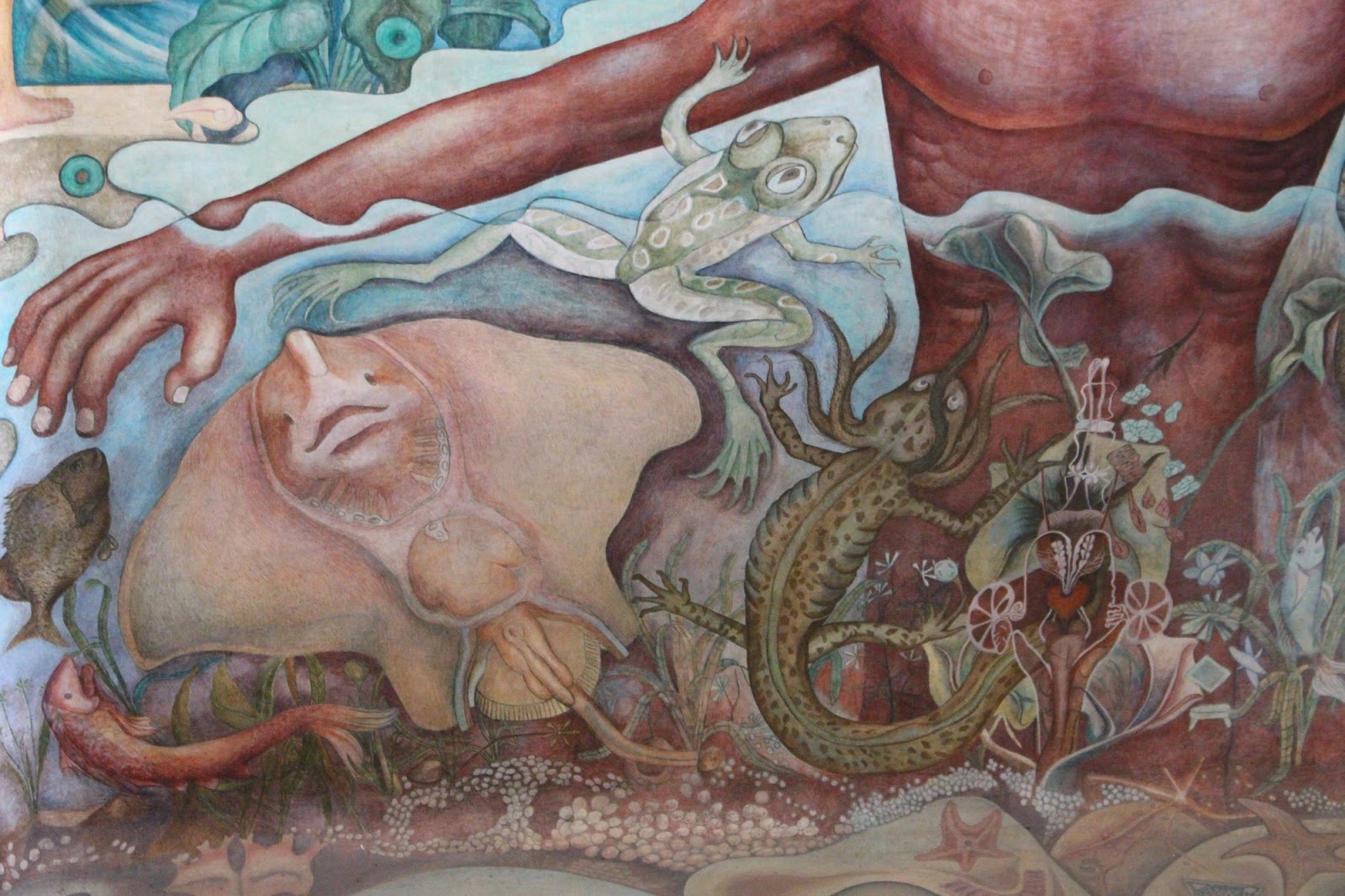
Diego Rivera’s Detroit Industry Murals in the central
courtyard of the Detroit Institute of Arts. For years I’ve wanted to see these,
perched as they are way up on the border with Canada, where a giant maple leaf
flies within view of the city, and they go halfsies on the summer firework show
with Windsor, Ontario, across the river.


Rivera did these in 1932. Commissioned by Edsel Ford, he
spent 3 months touring the auto plants and other factories doing hundreds of
sketches and studies. At that moment, Detroit represented the largest and most
technologically advanced industrial complex in the world. But it was also a
city full of racism, gangsterism, and violent suppression of organized labor.
Unemployment was at 25%, and the month Rivera got to town, there were thousands
of people on hunger strike at one of Ford’s plants. The Great Depression. (I mention
all this because, again, I have no pictures here. Because this didn’t get
painted. Because it complicated Rivera’s communist, industrial-utopian vision
of what was happening in the world. As well as his commission.) Still, some
absolutely breathtaking frescoes in the early industrial sublime.
Frida and Diego on West Canfield St., Detroit
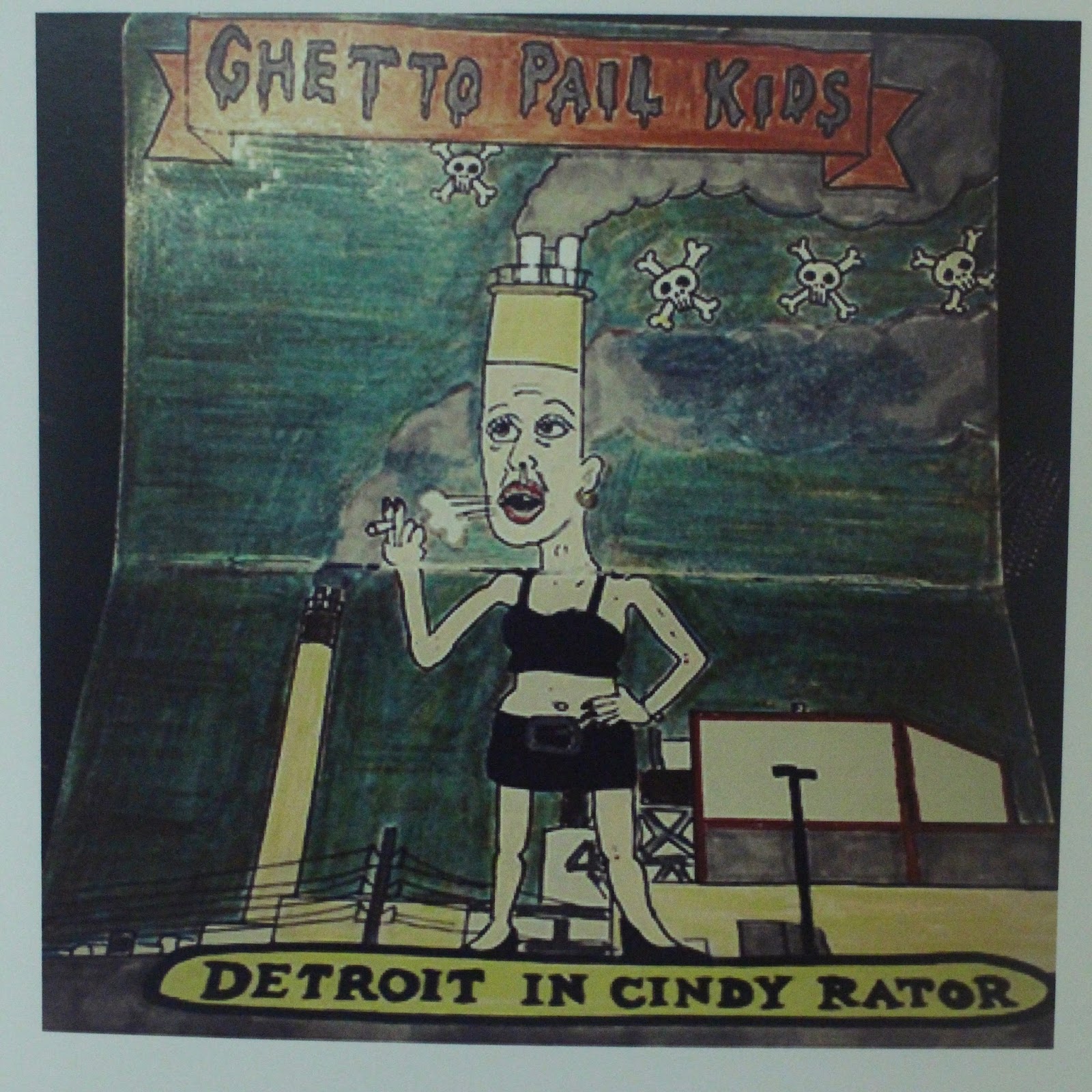
Jack White’s 3
rd Man Records
Bayard Kurth shows us around Cass Corridor’s fantastic
Ocelot Print Shop!
MNI WICONI - water is life
RECEDE IGNORE RECEDE IGNORE RECEDE IGNORE
Climate Justice prints & Ocelot's incinerator show
Justice requires that we eradicate desperate poverty before
we tolerate indecent luxury.
What we do to the mountain we do to ourselves.
Garrett MacLean took a job doing some wedding photos, not realizing
that condescending ruin porn was what the couple had in mind. New audience.
Astounding 9-year Mesoamerica Resiste print project from
Beehive Design Collective!
capitalismo y pan bimbo detail

León Felipe contemplates a concrete water weenie at the Casa
del Lago, Chapultepec Forest, CDMX
María José de la Macorra's "Derrumbadero lacustre"
at Casa del Lago
Dulce Chacón’s ink paintings
Diego Rivera's “Man at the Crossroads,” Palacio de Bellas
Artes, CDMX. (Recreated a year after the original, commissioned for NYC’s
Rockefeller Center, and then destroyed by Nelson Rockefeller when surprises
like a Soviet May Day parade and Vladimir Lenin started showing up in it.)
Rivera's "Agua, el origen de la vida" (Water,
Source of Life) (1952), in the Cárcamo de Dolores; (+
Fuente de Tlaloc & water organ!), Chapultepec
Park, CDMX
Nezahualcóyotl Fountain (under reconstructions), Chapultepec Park, CDMX
“Hydrology thus
restores the premodern sense of the lacustrine city, captured in the Náhuatl
place name “Mexico,” which is commonly believed to be derived from the words meztli (moon), xictli (navel), and co
(place): moon because of the shape and reflective qualities of the Lake Texcoco
as well as the resemblance of the configuration of the region’s interlinked
lakes as a whole to the “rabbit” shape of the moon’s craters; the navel, the
position of Tenochtitlan’s island in the lakes’ and lunar rabbit’s center. In
this toponym, there are no clear scalar divisions, the earth/moon becomes the
navel of the lake/sky.
“On the other
hand, Mexico City’s flowing water dissolves chemicals, body excretions, and
other substances, transferring them directly and indirectly (through crop
irrigation, for example) into our own bodies, and it also catches up trash and
debris within its flows, carrying them beyond their designated areas. The materiality
of water thus disrupts the conceptual enclosures with which modernity has
sought to abstract life from environment, and it reveals itself to have a being
of its own that disrupts its instrumentalization as mere resource for human
consumption.”
—Marc
Anderson, “The Grounds of Crisis and Geopolitics of Depth: Mexico City in the
Anthropocene,” Ecological Crisis and Cultural Representation in Latin America.
(2016)
Mueso Rufino Tamayo
¡Pastelería Ideal!
axolotl mosaic mural at embarcadero Belem in Xochimilco
Chavez Lopez family woodworking shop, on the shores of Lago Pátzcuaro.
(Last year they made a chair and some other furniture for Pope Francis.)
at
La Mano Gráfica. Pátzcuaro, Michoacán
“Dicen que el bosque
se extiende hasta el mar” by María Luisa Estrada Sánchez
from Alondra Alonso Alvarez’ #Mihuida print series
“La memoria y su frontera” by Alondra Alonso Alvarez
Axolotl mural at
La Jacaranda Cultural, Pátzcuaro
“This altar of la Dolorosa is dedicated to all of the
innocent victims of the so-called war on drugs and to the mothers of the
disappeared. A country dominated by weapons is a country flooded in pain.”
Mirador el Estribo
Morelos (inside and out) rises from Janitzio island.
El Gran Calavera
hazla de tos at l
a Cabrona
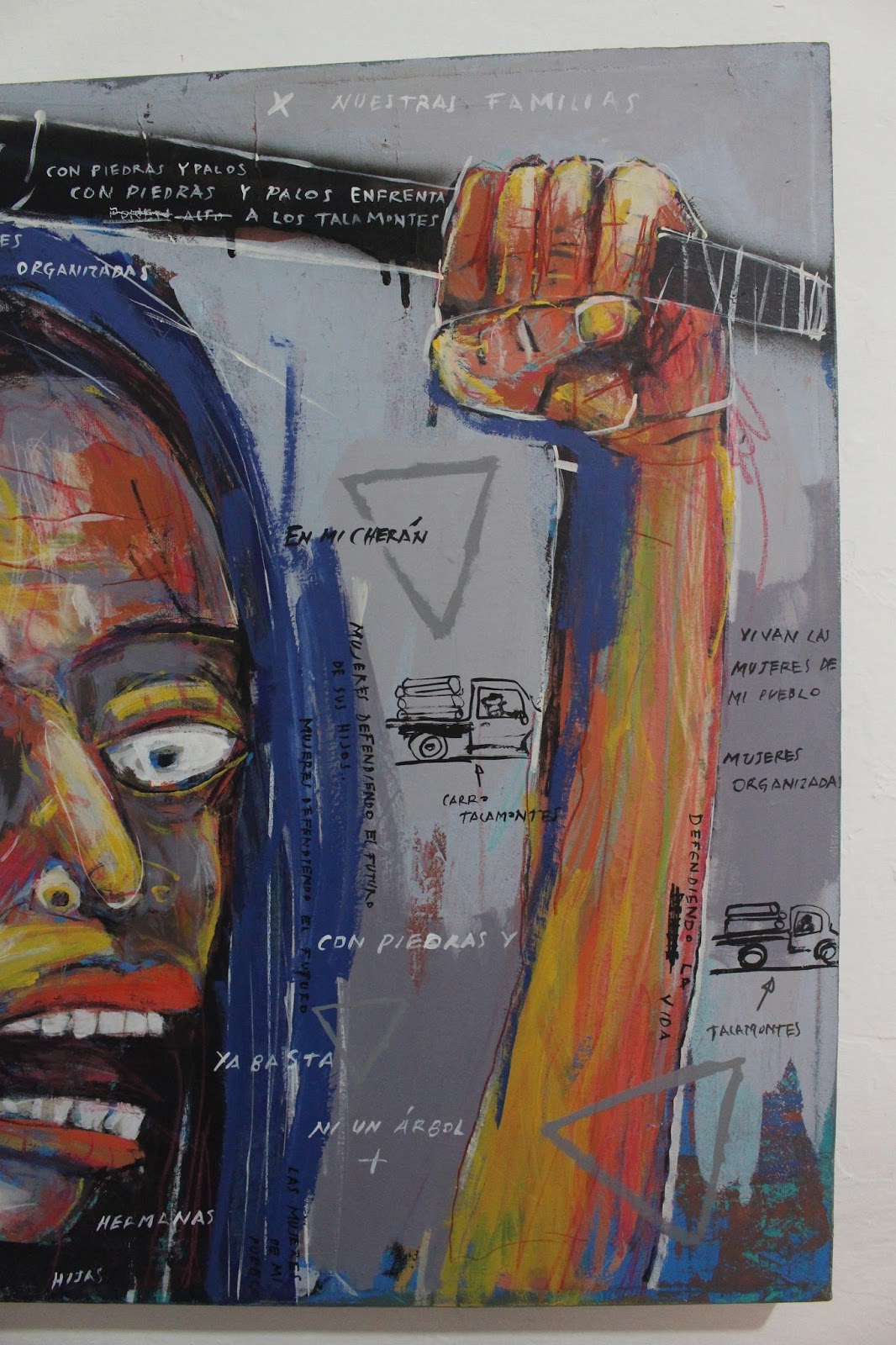
Angel Pahuamba's paintings in this series depict women’s
armed resistance to criminal logging and deforestation in his hometown of
Cherán, Michoacán.
and cumbias chingonas with Yermo Yerto