Monday, February 20, 2017

some presidents day

with Tom

with Ash

with Ash


with Tom

Tom's

with Ash (Trumunculus)

Thursday, February 16, 2017

Monday, February 13, 2017

cold war


eastern bloc soviet snowsuits

Sunday, February 05, 2017

Tuesday, January 24, 2017

ciphers in the snow


"Our kids are the keepers of a wild flame that may be nearly extinguished in ourselves; they are emissaries between the adult world and the wild world from which we emerged and upon which we have so often turned our backs. . . . Kids often speak in this forgotten language. We see in them some glimmer of how the natural world once appeared to us: immediate, new, strange, funny, waiting to be touched and played with. While it is we who teach our children the names of things, it is they who engage the things themselves, often spontaneously employing modes of perception, imagination, and intimacy that are no longer immediately available to us."

Michael Branch, from Raising Wild: Dispatches from a Home in the Wilderness

Friday, January 20, 2017

Wednesday, November 23, 2016

the found poetry of occasional dead-letter texts

is among the unexpected benefits of using a burner phone:

this is Forrest I was just wondering if you was around somewhere I got a new rifle I’d really like to show you I think you’d love it

The Springville evco had 26 hose crimps... Orem store has more if you want me to swing by.

Is this Mr Nelson

Did you send me an email about savvy women’s guide???

What’s going on? Is this guy going to give me trouble at the motel?

Friday, October 14, 2016

how to deal

The Art of the How to Deal with a Bloviating Asshat:


Monday, October 10, 2016

Dave Archambault II of the Standing Rock Sioux Nation address to the UN Human Rights Council - September 20, 2016


Human Rights Council President Choi Kyong-lim: I give the floor to the distinguished representative of Indian Law Resource Center.


Chairman Dave Archambault II: Thank you, Mr. President.

My name is Dave Archambault. I am the Chairman of the Standing Rock Sioux Tribe. Our tribal nation is a sovereign nation located in the United States. Our sovereignty is recognized by the United States through the legally binding treaties of 1851 and 1868, signed by our traditional Lakota government, Oceti Sakowin (Oceti Šakowin, the Seven Council Fires), then passed by the United States Senate, and proclaimed by the President of the United States.

I am here because oil companies are causing the deliberate destruction of our sacred places and burials. Dakota Access Pipeline [Dakota Access, LLC, a subsidiary of Energy Transfer Partners; a.k.a. "Dakota Access"] wants to build an oil pipeline under the river that is the source of our nation's drinking water. This pipeline threatens our communities, the river, and the earth.

Our nation is working to protect our waters and our sacred places for the benefit of our children not yet born. But the oil companies and the government of the United States have failed to respect our sovereign rights. Today, the pipeline construction continues. Although it has temporarily stopped near our nation, this company has knowingly destroyed sacred sites and our ancestral graves with bulldozers. This company has also used attack dogs to harm individuals who tried to protect our water and our sacred sites.

I condemn all violence, including the use of guard dogs.

While we have gone to the court in the United States, our courts have failed to protect our sovereign rights, our sacred places, and our water. We call upon the Human Rights Council and all Member States to condemn the destruction of our sacred places and to support our nation's efforts to ensure that our sovereign rights are respected. We ask that you call upon all parties to stop the construction of the Dakota Access Pipeline and to protect the environment, our nation's future, our culture, and our way of life.

Thank you, Mr. President.

Wooden Duck

Just to think, I may be the first.
I walk through the small iron door,
    small like an Anasazi opening.
There on the stool
    a bearded English man pours sour ale.

The stained glass windows speak a story:
    a running rabbit, a human caterpillar,
    a disappearing cat, and a queen of hearts.
My emotions ebb like those of Alice's, out of place.

Outside the window—
    a green hill supporting Windsor castle.
It stands like an adobe village atop a mesa.
The ground is black soil,
No signs of the red reservation dirt.

A small black bird perches on the wooden sill.
Is it a corn-stealing reservation chicken?
No. It's a Scottish raven, and Indian crow mirage.

No frybread with mutton stew.
I order Yorkshire pudding,
A meat pie.

Around the pub
    spreads the spired city of learning: Oxford.
Like tipis of the annual Crow Fair,
    these colleges choke the town:

Pembroke, Old Crow; St. Peters, Black Eagle; Christ Church,
Red Wolf: Magdalen, Old Coyote . . . . 

Here in the pub
    Queen Elizabeth rules by her crown.
Across the great diving lakes,
Within the sacred mountains,
Grandmother Little Owl weaves her loom.

In this room,
I am the red Columbus.
There are no Indian brothers.

I hear the echo of an eagle,
The sun dance drums,
Whistling Canyons.
But the wailing spirits of Stonehenge
    silence their chants.

I truly am the first Navajo in the Wooden Duck.

Hershman John, I Swallow Turquoise for Courage (2007) 

the New World

I see him as a funnel and through this funnel the New World pours into my genes and becomes, perhaps, the saving remnant. For what this discovered hemisphere gave us is a chance to recover the irrational, the illogical, and the powerful. The forests that overwhelm us, the mountains that dwarf us, the forces that crush us. Here the drums were not yet stilled. Here God still lived, though at times God drank copious goblets of blood, or was a stone, or a buffalo skull, or a mountain.

But the mess we lament, that is the thing that a part of me celebrates. The strange mongrel mixture of races, ideas, seeds, spores, viruses, bacteria.

The landmass we call Europe had been butchered, all the forests made groves, all the meadows made fields, all the ground made tame. All the signs of decadence were present  and this failure of the heart was seen as innovation. A new burst was occurring in writing, in painting, in machines. The things scholars for the coming centuries would celebrate and call a rebirth, these things were actually signs of a vast dying of the spirit. Of this I am convinced because five centuries later I live at a similar moment in the history of my breed. We too live in a dead culture with dead gods and yet we are flailing outward into space, the depths of the seas, the secret crevices of the earth, the once sacrosanct gardens of our cells. We are mining the double helix, poking about in the strange codes of life itself. We sail on our clumsy caravels and galleons just as Christopher himself once did.

What the jungles and plains and mountains and deserts and forests of the New World accomplished is this: they permanently poisoned the faith of Europeans in rationality. They brought us back the night.

— Charles Bowden, Blood Orchid: An Unnatural History of America (1995)

Wednesday, July 20, 2016

another way to live, anything at all


Imagine the problem is not physical. Imagine the problem is that we cannot imagine a future where we possess less, but are more. Imagine the problem is a future that terrifies us, because we lose our machines, but gain our feet and pounding hearts.

Then, what is to be done? We do not want to learn another way to live. We would rather die.

Or, perhaps a voice will come down from the mountain, a bush will burn, new tablets of stone will heave into view like spacecraft. We could turn it all around. Take power. The answers are as simple as the questions.

We are an exceptional model of the human race. We no longer know how to produce food. We no longer can heal ourselves. We no longer really raise our young. We have forgotten the names of the stars, fail to notice the phases of the moon. We do not know the plants and they no longer protect us. We tell ourselves we are the most powerful specimens of our kind who have ever lived. But when the lights are off we are helpless. We cannot move without traffic signals. We must attend classes in order to learn by rote numbered steps toward how to love or how to breast-feed our baby. We justify anything, anything at all, by the need to maintain our way of life. We have a simple test for making decisions: our way of life, which we cleverly call our standard of living, must not change except to grow yet more grand. We have a simple reality we live with each and every day: our way of life is killing us.

Still we could be free. We could walk out the door. We can still walk a little or at least crawl.

We can, actually, do anything. Anything at all.

— Charles Bowden, Blood Orchid: An Unnatural History of America (1995)

Thursday, June 30, 2016

Virtually Teotitlán del Valle


Virtually everyone in Teotitlán del Valle has a deep and detailed knowledge of weaving and dying, and all that goes with it—carding, combing the wool, spinning the yarn, raising the insects on their favorite cacti, picking the right indigo plants. A total knowledge is located, embodied in the individuals, the families of this village. No “experts” need to be called in, no external knowledge which is not already in the village. Every aspect of the expertise is located right here.
How different this is from our own, more “advanced” culture, where nobody knows how to make anything for themselves. A pen, a pencil—how are these made? Could we make one for ourselves, if we had to? I fear for the survival of this village, and the many like it, which have survived for a thousand years or more. Will they disappear in our super-specialized, mass-market world?

— Oliver Sacks, Oaxaca Journal (2002)


In the valley of Oaxaca, old ways combined with practical new ideas and crafts. The idea of each village specializing in a craft was very ancient. It went back to the days of Monte Albán. But what they specialize in and how they make it, has changed over time. Teotitlán del Valle is a good example. Those folks have been weavers for centuries. Now they’re famous for rugs, but it used to be clothes. Then a man named Isaac Vásquez and his family started making rugs. Isaac worked for a while in New York as a cabbie in the 1980s. And his clients told him, “Hey, you know, tourists really like rugs.” So he went back to Teotitlán del Valle and started making rugs. Now, there’s about 150 different families there that are making rugs. They use European looms, they’re no longer using the backstrap loom. And artist Rufino Tamayo revived the local dyes, so now they’re using traditional dyes in combination with these European looms. And they can make any design; they’re amazing. They uses these looms like a painter uses a canvas. Their largest client are the Navajo up in the United States. They’re making Navajo style rugs for the Navajo to sell on their reservations.

— Edwin Barnhart


Pastora of Vida Nueva/Galvain Cuy women’s weaving cooperative drops some knowledge.


indigo/añil
 

cochineal/cochinilla


Tlamanalli


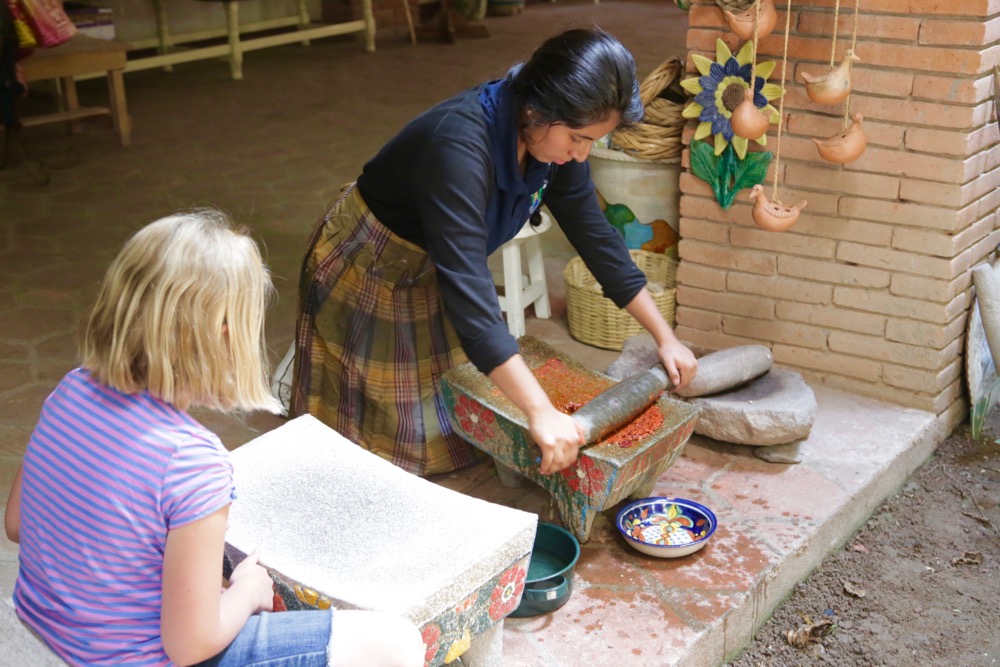
metate


mescal works